
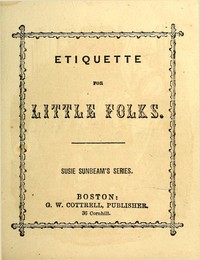
Etiquette for Little Folks by Mrs. Henry S. Mackarness
First published in 1879, Etiquette for Little Folks is exactly what the title promises. Written by Mrs. Henry S. Mackarness, it's a comprehensive rulebook for Victorian children. The book is structured as a series of lessons and conversations, often between a mother and her children, covering the vast landscape of proper behavior.
The Story
There isn't a traditional plot with characters going on a journey. Instead, the 'story' is the guided tour of a Victorian child's social world. Mrs. Mackarness walks her young readers through detailed scenarios: how to enter and leave a room, how to speak to elders and servants, the correct way to eat every type of food, and how to conduct oneself at parties, school, and church. It goes beyond mere politeness, drilling into duty, modesty, and self-control. The advice ranges from the practical ('Don't bite your nails') to the intensely moral ('Never be ashamed of your parents, however humble they may be'). It paints a vivid picture of a society where every action was a public statement about your character and upbringing.
Why You Should Read It
This book is a social history goldmine. Reading it today is less about learning manners and more about peeking through a keyhole into the past. The priorities are so different! There's a huge emphasis on silence, obedience, and not drawing attention to yourself—concepts that feel foreign in our modern, child-centric world. Some passages are genuinely sweet in their earnestness, while others will make you gasp at their strictness. It’s this mix that makes it so engaging. You’ll find yourself constantly comparing then and now, wondering which rules we've lost for the better, and if we've maybe thrown a few useful ones out with the bathwater.
Final Verdict
This isn't a page-turner in the usual sense, but it's utterly compelling for the right reader. It's perfect for history buffs, parents, and teachers who want to understand the social pressures of the Victorian era firsthand. If you love shows like Downton Abbey or are fascinated by everyday social history, you'll get a kick out of this. It's also a great, short read for anyone who enjoys primary sources that haven't been filtered through a modern lens. Just be prepared for some seriously old-fashioned ideas!
This book is widely considered to be in the public domain. Access is open to everyone around the world.
Emily Hernandez
2 months agoI was particularly interested in the case studies mentioned here, the insights into future trends are particularly thought-provoking. It definitely lives up to the reputation of the publisher.
Paul Smith
5 months agoI took detailed notes while reading through the chapters and the quality of the diagrams and illustrations (if applicable) is top-notch. A trustworthy resource that I'll keep in my digital library.
Robert Brown
2 years agoAfter a thorough walkthrough of the table of contents, it manages to maintain a consistent flow even when discussing difficult topics. It cleared up a lot of the confusion I had previously.






Elizabeth Lopez
1 year agoA sophisticated analysis that fills a gap in the literature.