
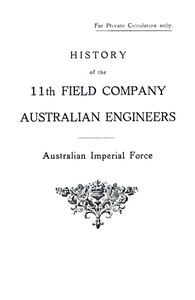
History of the 11th Field Company Australian Engineers, Australian Imperial…
Most war stories focus on the infantry charging across no-man's-land. This book flips that script entirely. History of the 11th Field Company Australian Engineers is the unit's own chronicle, likely written by the men who served in it. It follows these soldiers from their training in Australia through their deployment to the Western Front, not as fighters with rifles, but as builders and problem-solvers under fire.
The Story
The narrative walks you through their war, day by day, task by task. You're with them as they land in France, confronting the sheer scale of the logistical nightmare. The 'plot' is their work: constructing command posts under shelling, laying miles of duckboards over swamps, digging deep tunnels for mines, and constantly repairing what the enemy artillery destroys. Major battles like Passchendaele and Villers-Bretonneux form the backdrop, but the focus stays on the company's specific, gritty contributions. There are moments of sudden horror—a working party caught in a barrage—and long stretches of grinding, wet, cold labour. It ends with their return home, a quiet conclusion to a war fought with shovels and wire-cutters as much as with bullets.
Why You Should Read It
This book gives you a perspective you simply won't find in standard histories. It makes the war feel real in a different way. You get a profound respect for these men's skills and their quiet courage. There's no glorification here; it's a matter-of-fact record of a tough job. What moved me most was the sense of ordinary men applying their trades—carpenters, surveyors, miners—in an utterly extraordinary and hellish situation. Their ingenuity and perseverance in the face of impossible conditions is the true heart of the story. Reading their dry reports of a 'successful sap' or a 'bridge completed under harassing fire' carries more weight than any dramatic speech.
Final Verdict
This is a specialist's book, but its appeal is broader than you might think. It's perfect for history buffs who want to move beyond the battle maps, for anyone with an interest in military engineering, or for Australians wanting to connect with a very specific part of their ANZAC heritage. It's not a light read—it's dense with detail and place names—but it is a deeply rewarding one. Think of it as the essential, behind-the-scenes documentary to the main feature film of WWI. If you've ever looked at a photo of a trench and wondered, 'How did they even build this?', this book has your answers.
You are viewing a work that belongs to the global public domain. You do not need permission to reproduce this work.
Daniel Moore
1 year agoWithout a doubt, the narrative structure is incredibly compelling. Definitely a 5-star read.
Kevin Rodriguez
1 year agoI came across this while browsing and the clarity of the writing makes this accessible. Thanks for sharing this review.
Matthew Lee
1 year agoI didn't expect much, but the depth of research presented here is truly commendable. Don't hesitate to start reading.



Ashley Martinez
1 year agoBased on the summary, I decided to read it and the author's voice is distinct and makes complex topics easy to digest. Thanks for sharing this review.