
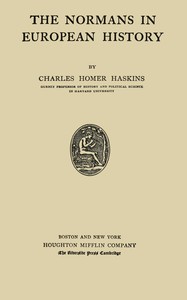
The Normans in European history by Charles Homer Haskins
Forget the dry, fact-heavy history books you might remember from school. Charles Homer Haskins’s The Normans in European History is different. It reads like a guided tour through one of the most dynamic periods of the Middle Ages, led by a scholar who’s genuinely excited to show you around.
The Story
This isn't a novel with a single plot, but the story it tells is incredible. It follows the journey of the Normans from their origins as Viking settlers in northern France (Normandy) to becoming a dominant force across Europe. Haskins maps their expansion like following the branches of a mighty tree. One branch leads to William the Conqueror and the dramatic takeover of England in 1066. Another stretches south, where Norman adventurers carved out kingdoms in the sun-drenched landscapes of southern Italy and Sicily. Yet another reaches east, to their role in the Crusades. The core narrative is how this one people absorbed French culture, blended it with their own Norse drive, and used that unique combination to build, administer, and connect disparate parts of a continent.
Why You Should Read It
What makes this book special is its focus on connection. Haskins doesn't just list conquests; he shows the links. You see how administrative ideas from Normandy were applied in England, and how the cosmopolitan Norman kingdom in Sicily became a brilliant meeting point of Latin, Greek, and Arab cultures. It shatters the idea of the Middle Ages as isolated and backward. Instead, you get a picture of a networked, mobile world where ambition and adaptation could rewrite the map. Haskins makes you appreciate the Normans not just as warriors, but as shrewd state-builders and cultural magpies whose legacy is woven into the fabric of modern Europe.
Final Verdict
This is the perfect book for anyone curious about the Middle Ages but unsure where to start. It’s also a treat for history buffs who want to see the big picture. If you enjoyed shows like Vikings or The Last Kingdom and want to know ‘what happened next,’ this is your next read. Haskins’s prose is clear and direct, avoiding academic jargon. While it’s a serious work of history, it feels like listening to a great storyteller connect the dots. You’ll finish it looking at Europe—and perhaps even the idea of cultural identity—in a new way.
This title is part of the public domain archive. You are welcome to share this with anyone.
Richard Jones
11 months agoIt’s refreshing to see such a high standard of digital publishing.
Linda Perez
1 year agoAs a professional in this niche, the evidence-based approach makes it a very credible source of information. A perfect balance of theory and practical advice.
James Jones
5 months agoHaving explored several resources on this, I find that the clarity of the writing makes even the most dense sections readable. Well worth the time invested in reading it.
Mary Harris
7 months agoIt’s rare to find such a well-structured narrative nowadays, the attention to detail regarding the core terminology is flawless. I'm glad I chose this over the other alternatives.




Christopher Lopez
1 month agoThe balance between academic rigor and readability is perfect.