About 53 minutes
My Shipmate—Columbus — Inside the Classic
Space Future
12,125 recorded words. 3 minutes difference from this book's estimate.
View Gutenberg source #27019
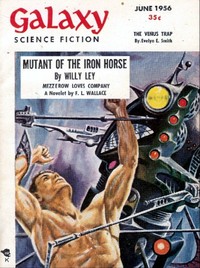
The source record for The Venus Trap — Context and Discussion measures this digital text at 12,803 words, 56 min estimated reading time, and 2 detected text sections.
The text analysis averages about 14.1 words per sentence, while the detected sections provide another way to judge how the source is divided.
Project Gutenberg metadata also associates the work with “Science fiction,” connecting these edition facts with the source record’s subject description.
Explore this collection
These alternatives are selected using recorded categories and estimated reading time.
About 53 minutes
Space Future
12,125 recorded words. 3 minutes difference from this book's estimate.
View Gutenberg source #27019About 48 minutes
Space Future
10,942 recorded words. 8 minutes difference from this book's estimate.
View Gutenberg source #31929About 47 minutes
Space Future
10,783 recorded words. 9 minutes difference from this book's estimate.
View Gutenberg source #29432Search stored excerpts and compare books → Choose by your preferences →
Choices use stored catalog measurements. Estimates vary with reading speed. A shared category is a catalog label, not a claim that two books have the same argument or literary quality.
Search reads excerpt text stored with this catalog and links to its associated Gutenberg record. The connection is stored in the site database; this tool does not recheck that every excerpt is word-for-word identical to that external record. Excerpt search does not cover every chapter and does not verify historical publication dates.
Catalog snapshot checked: 2026-09-26. Coverage: 96 public books, 96 available source excerpts.
Calculated from edition completeness, EPUB availability, text structure and catalogue metadata. Not a user rating.
Total of 100 points, scaled to a 2.5-5.0 range. Editions with an empty description or a missing EPUB file are not scored.
Public-domain source text
The source text is kept in the dedicated reader, separate from this catalogue record and its commentary.
The Venus Trap opens not with a spaceship landing but with a husband anxiously asking his wife if she likes the planet. The blue grass, blue-violet shrubbery, and a golden tree with sapphire leaves are described as fairy-tale beautiful—yet the wife, Phyllis, has just fainted. The narrator notes that most colonized planets 'tended, from the human viewpoint, anyway, to stink,' but this one is pleasing to both nose and eye and free of hostile natives. The only apparent life is bird-like creatures and harmless insects. The tension, however, is not external but domestic: a constraint between James and Phyllis that the public ethergrams of his voyage could not bridge. The story's first pages thus establish a pattern of idyllic surface and private unease.
The opening description of Venus as a 'fairy-tale version of Earth' is immediately undercut by Phyllis's distress. The narrator's dry aside about planets that 'stink' sets a wry, pragmatic tone that contrasts with the lush setting. Smith uses the colony's perfection to highlight human dissatisfaction: the blue vegetation is lovely, but Phyllis later confesses she would 'lose my mind' never seeing a green leaf again. The 'everblue' trees never shed leaves, creating a static, oppressive beauty. This tension between the planet's apparent paradise and the characters' emotional reality is the story's central engine.
Midway through the excerpts, a new character appears: Magnolia, a sentient tree. James reads her a zoology chapter on mammalian reproduction, explaining where babies come from. Magnolia, puzzled, asks 'Where do the bees come in?'—a moment of alien logic that defamiliarizes human biology. The triangle becomes literal: James, his pregnant wife Phyllis, and the tree he has befriended. Phyllis's jealousy is palpable—she interrupts to remind James of his hurry to Base, wiping her hands on a dish towel. The tree, meanwhile, offers to be godmother. Smith plays the situation for both comedy and discomfort, as James tries to manage two very different kinds of relationship.
Reproduction is a recurring motif, from Phyllis's pregnancy to the tree's desire to fruit. James explains that the colony has a 'conservation program' to get pollen from trees on the other side of the planet, but Magnolia rejects the idea of fruiting without love: 'I would rather not fruit at all than—' The human characters are similarly constrained: James and Phyllis's marriage is strained by the pregnancy, and their communication remains superficial. The story uses these parallel reproductive dilemmas to explore how biology and emotion can be at odds, especially in an alien environment where even the plants have opinions.
Smith's narrative voice is key: it is wry, observational, and slightly detached. The opening line—'One thing Man never counted on to take along into space with him was the Eternal Triangle'—frames the story as a joke on human assumptions. The structure alternates between dialogue-heavy scenes and brief narrative commentary, keeping the focus on interpersonal conflict rather than action. The excerpts show no space battles or alien threats; the danger is emotional. The story's brevity (12,803 words) and serial origin (Galaxy Science Fiction, June 1956) suggest a tight, ironic tale that uses science fiction conventions to examine marriage and miscommunication.
Readers should pay attention to what is not said: the gaps in James and Phyllis's conversations, the unspoken resentments, and the way the alien setting mirrors their estrangement. The Venus Trap rewards attention to its small, telling details—the dish towel, the ethergrams, the tree's literal-mindedness—rather than plot twists. Approach it as a character study with a satirical edge, and let the blue landscape and talking tree amplify, rather than distract from, the human drama at its center.
I’ve often thought the talking tree in The Venus Trap holds a certain loneliness beneath its satire, a green patience waiting to be understood. That quiet bewilderment lingers with me, much like the gentle strangeness of One Martian Afternoon — Story, Setting & Ideas—two alien afternoons, each asking what it means to be heard across a garden’s silence.
Create a short personal record of your experience with this book.









