About 51 minutes
Shock Absorber — Inside the Classic
Social Speculation
11,624 recorded words. 13 minutes difference from this book's estimate.
View Gutenberg source #24380
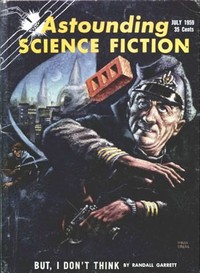
But, I Don't Think — Inside the Classic can be approached with a clearer sense of reading commitment from its source measurements: 14,688 words, 1 hr 4 min estimated reading time, and 2 detected text sections.
The text analysis averages about 15.5 words per sentence, while the detected sections provide another way to judge how the source is divided.
Project Gutenberg metadata also associates the work with “Science fiction,” connecting these edition facts with the source record’s subject description.
Explore this collection
These alternatives are selected using recorded categories and estimated reading time.
About 51 minutes
Social Speculation
11,624 recorded words. 13 minutes difference from this book's estimate.
View Gutenberg source #24380About 50 minutes
Social Speculation
11,279 recorded words. 14 minutes difference from this book's estimate.
View Gutenberg source #26966About 80 minutes
Social Speculation
18,350 recorded words. 16 minutes difference from this book's estimate.
View Gutenberg source #29475Search stored excerpts and compare books → Choose by your preferences →
Choices use stored catalog measurements. Estimates vary with reading speed. A shared category is a catalog label, not a claim that two books have the same argument or literary quality.
Search reads excerpt text stored with this catalog and links to its associated Gutenberg record. The connection is stored in the site database; this tool does not recheck that every excerpt is word-for-word identical to that external record. Excerpt search does not cover every chapter and does not verify historical publication dates.
Catalog snapshot checked: 2026-09-26. Coverage: 96 public books, 96 available source excerpts.
Calculated from edition completeness, EPUB availability, text structure and catalogue metadata. Not a user rating.
Total of 100 points, scaled to a 2.5-5.0 range. Editions with an empty description or a missing EPUB file are not scored.
Public-domain source text
The source text is kept in the dedicated reader, separate from this catalogue record and its commentary.
The story opens with the merchant ship Naipor settling into its landing cradle on Viornis, a descent described with mechanical precision: the ship's mass is handled “as gently as an egg being settled into an egg crate.” This image of controlled, fragile placement echoes throughout the narrative, which repeatedly juxtaposes rigid social structures with the unpredictable human element. The protagonist, known only as The Guesser, is introduced in the act of berating a subordinate, Kraybo, for failing to use his predictive ability. The Guesser's impatience and his physical threat—Kraybo has “felt the back of The Guesser's hand too often”—immediately establish a world where hierarchy is enforced through both rank and violence.
The Guesser is a trained precognitive, a specialist whose value lies in his ability to predict outcomes. The narrative makes clear that his position is both privileged and precarious: he is a first-class predictor, but his father worried he might become an Executive, and his mother secretly hoped for that. This family tension hints at a society where one's role is determined by aptitude testing, not choice. The Guesser's authority is absolute within his domain—he speaks in a voice “accustomed to giving orders that would be obeyed”—yet his identity is entirely tied to his function. He has a name, we are told, but he “almost never used it; he hardly ever even thought of it.” This depersonalization underscores the caste system's power to subsume individual identity into occupational label.
When the Sixer woman suggests joining the Misfits, The Guesser is forced to confront what he knows—and does not know—about this outlaw group. The narrative presents his thoughts in a stream of half-remembered history: the Misfits are the descendants of criminals and pioneers shipped to distant planets, their society a “near-anarchic form of ochlocracy.” The Guesser's ignorance is emphasized; he cannot recall what the Misfits call themselves, and his knowledge of ancient history is “as confused as anyone's.” This deliberate vagueness mirrors the Aristarchy's propaganda: the Misfits are defined by what they are not—not civilized, not part of the system. Yet the woman's offer presents a concrete alternative, and The Guesser's internal debate reveals the cracks in his worldview.
The story's structure is built around transitions between enclosed environments: the ship's corridors, the Guesser's quarters, the landing cradle, and later the planet's surface. Each space carries its own social rules. The ship is a microcosm of the Aristarchy, with clear zones of authority—Fire Control, the Executive offices, the crew quarters. The landing cradle, described as a “hydraulic bath,” is a liminal space where the ship is no longer in flight but not yet grounded. The Guesser's movement from ship to planet is also a movement from certainty to uncertainty. The narrative lingers on the physical sensations of these transitions: the “vast, metallic sighing” of the cradle, the silence after the antigravs cut off. These details ground the speculative elements in tangible, sensory experience.
Garrett uses repeated images of containment—eggs, cradles, ships, social classes—to reinforce the theme of entrapment. The ship is “held” by the cradle; the Guesser is held by his role; the Sixer woman is held by her low status. The egg simile recurs in the opening and echoes in the idea of a “hatching” into a new life. Escape is figured as a movement outward, toward the Misfits, but the narrative never romanticizes it. The Guesser finds the idea “shocking” and “alien.” The text also uses the image of the hand: The Guesser's hand strikes Kraybo, but later he is helpless, his hand metaphorically empty. These physical details—the egg, the cradle, the hand—create a consistent visual language that ties the personal to the societal.
Readers should pay attention to the way Garrett builds the world through the Guesser's limited perspective. The story never steps outside his viewpoint, so the Aristarchy and the Misfits are both filtered through his biases and gaps in knowledge. This technique makes the social critique more subtle: the reader must infer the system's flaws from what the protagonist does not see. The excerpts suggest a narrative that moves from interior monologue to action, but the full arc of the Guesser's decision is not shown here. The tension between his trained obedience and his dawning doubt is the engine of the story.
That rainy afternoon, I kept turning over how Garrett’s Guesser aches for a life beyond his cage, until the quiet dread of that thought felt familiar—then I stumbled onto another book, Skin Game — Inside the Classic, which seemed to pick up that same lonely yearning, though in a different skin. I closed one, opened the other, and the rain never really stopped.
Use these questions to collect your thoughts before moving on.