About 18 minutes
Quiet, Please — Key Ideas to Explore
Social Speculation
3,982 recorded words. 2 minutes difference from this book's estimate.
View Gutenberg source #21541
Before opening Untechnological Employment — Context and Discussion, the edition data offers a quick orientation: 3,579 words, 16 min estimated reading time, and 1 detected text section.
The text analysis averages about 25.0 words per sentence, while the detected sections provide another way to judge how the source is divided.
Project Gutenberg metadata also associates the work with “Science fiction,” connecting these edition facts with the source record’s subject description.
Explore this collection
These alternatives are selected using recorded categories and estimated reading time.
About 18 minutes
Social Speculation
3,982 recorded words. 2 minutes difference from this book's estimate.
View Gutenberg source #21541About 21 minutes
Social Speculation
4,744 recorded words. 5 minutes difference from this book's estimate.
View Gutenberg source #26751About 21 minutes
Social Speculation
4,772 recorded words. 5 minutes difference from this book's estimate.
View Gutenberg source #29954Search stored excerpts and compare books → Choose by your preferences →
Choices use stored catalog measurements. Estimates vary with reading speed. A shared category is a catalog label, not a claim that two books have the same argument or literary quality.
Search reads excerpt text stored with this catalog and links to its associated Gutenberg record. The connection is stored in the site database; this tool does not recheck that every excerpt is word-for-word identical to that external record. Excerpt search does not cover every chapter and does not verify historical publication dates.
Catalog snapshot checked: 2026-09-26. Coverage: 96 public books, 96 available source excerpts.
Calculated from edition completeness, EPUB availability, text structure and catalogue metadata. Not a user rating.
Total of 100 points, scaled to a 2.5-5.0 range. Editions with an empty description or a missing EPUB file are not scored.
Public-domain source text
The source text is kept in the dedicated reader, separate from this catalogue record and its commentary.
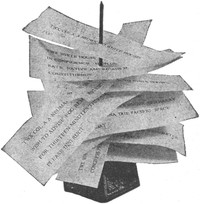
Ed M. Clinton's "Untechnological Employment" unfolds entirely through TWX messages, a format that immediately signals bureaucratic urgency and miscommunication. The story opens with a White House query about moon launch delays, answered with a single word: "Fog." This terse exchange sets the tone for a narrative where institutional language masks absurdity. The catalog lists this as science fiction and epistolary fiction, and the excerpts confirm both: the setting is a Pacific Spaceport, and the entire plot is conveyed through official telegrams. However, the story's speculative core—a political solution involving Native American sun dances—emerges only gradually, embedded in the bureaucratic back-and-forth. The excerpts show a shift from weather reports to cultural intervention, but the full implications remain unclear without the complete text.
The story's reliance on TWX messages creates a distinctive rhythm. Each message is a compressed unit of information, often with a single subject: weather, political pressure, personnel changes. The White House's insistence on launching despite fog is conveyed through escalating demands: "FLY THIS WEEK OR HE WILL INVESTIGATE." The commanders' responses are equally clipped: "SIR INVESTIGATE" and "ADVISE YOU THIS OFFICE REGARDS WASHWATER SUGGESTION AS NOT ACCEPTABLE." This format eliminates description, forcing the reader to infer setting and emotion from subtext. Colonel Neuman's suicide is reported in a single line: "COL. NEUMAN'S DEATH ESTABLISHED AS SUICIDE." The bureaucratic tone persists even in crisis, highlighting how institutional language can sanitize tragedy.
The excerpts reveal a plot where a senator's recommendation—likely involving Native American rituals—is initially rejected, then accepted under political pressure. The White House's confidential messages cite "HIGH UNEMPLOYMENT RATE NATIVE AMERICANS IN WASHWATER CONSTITUENCY" as a reason to re-evaluate. This suggests the sun dance is not a genuine solution but a political expedient. The acting commander's reports of "DANCING BEGAN AT OH FOUR TWENTY" and "CHIEF BLUE SKY DECLARES REPERTOIRE OF SUN DANCES FAR FROM EXHAUSTED" treat the ritual as a weather-control procedure. The story appears to critique how indigenous practices can be co-opted by state institutions, but the excerpts do not reveal the perspective of the Native American participants themselves.
Despite its science fiction classification, the story's speculative content is minimal in the excerpts. The spaceport setting and moon launch goal are present, but the technology is never described. Instead, the speculative twist is the efficacy of the sun dance: after the dancing begins, the fog clears and a launch succeeds. The acting commander's final message notes "WEATHER CONTROL PERSONNEL ASKING FOR OVERTIME" and offers his resignation, suggesting the solution is both effective and absurd. The story thus uses a fantastical premise to satirize bureaucracy and political decision-making. The catalog's secondary topic "general-literature" is apt, as the work's focus is less on futuristic technology than on human systems and their failures.
Readers should approach "Untechnological Employment" as a satire of institutional communication, where the medium—the TWX message—shapes the message. The story's brevity (under 4,000 words) rewards attention to the gaps between messages. The excerpts leave open whether the sun dance is genuinely supernatural or merely coincidental; the full text may clarify this. The work's cataloging as both science fiction and epistolary fiction is accurate, but its primary interest may lie in its critique of political expediency.
That rainy afternoon, the TWX messages about fog delaying the moon launch felt so oddly human—bureaucracy wrestling with weather. It made me think of how rules bend around stubborn realities. Later, I found myself reading Skin Game — Inside the Classic, and the same quiet absurdity lingered, like a familiar ache. Some stories just live in that space between procedure and the inexplicable.
Use these questions to collect your thoughts before moving on.