About 40 minutes
The Circuit Riders — Edition Insights
Machines Invention
9,166 recorded words. 0 minutes difference from this book's estimate.
View Gutenberg source #24543
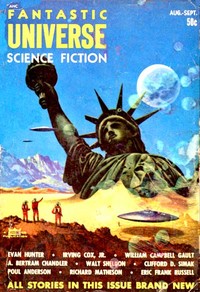
The source record for The Very Black — Context and Discussion measures this digital text at 9,086 words, 40 min estimated reading time, and 1 detected text section.
The text analysis averages about 11.5 words per sentence, while the detected sections provide another way to judge how the source is divided.
Project Gutenberg metadata also associates the work with “Science fiction,” connecting these edition facts with the source record’s subject description.
Explore this collection
These alternatives are selected using recorded categories and estimated reading time.
About 40 minutes
Machines Invention
9,166 recorded words. 0 minutes difference from this book's estimate.
View Gutenberg source #24543About 43 minutes
Machines Invention
9,715 recorded words. 3 minutes difference from this book's estimate.
View Gutenberg source #26206About 43 minutes
Machines Invention
9,881 recorded words. 3 minutes difference from this book's estimate.
View Gutenberg source #26761Search stored excerpts and compare books → Choose by your preferences →
Choices use stored catalog measurements. Estimates vary with reading speed. A shared category is a catalog label, not a claim that two books have the same argument or literary quality.
Search reads excerpt text stored with this catalog and links to its associated Gutenberg record. The connection is stored in the site database; this tool does not recheck that every excerpt is word-for-word identical to that external record. Excerpt search does not cover every chapter and does not verify historical publication dates.
Catalog snapshot checked: 2026-09-26. Coverage: 96 public books, 96 available source excerpts.
Calculated from edition completeness, EPUB availability, text structure and catalogue metadata. Not a user rating.
Total of 100 points, scaled to a 2.5-5.0 range. Editions with an empty description or a missing EPUB file are not scored.
Public-domain source text
The source text is kept in the dedicated reader, separate from this catalogue record and its commentary.
The Very Black opens with a narrator who is certain he will die, and the story never lets the reader forget that certainty. The first-person voice is immediate, colloquial, and laced with period slang—'the Doll,' 'Baby,' 'goose pimples'—that establishes a hard-boiled tone reminiscent of mid-century pulp. Yet the narrative quickly undercuts that bravado with an undercurrent of dread. The protagonist, Eddie Anders, is a test pilot assigned to fly a new 'triangular ship'—a saucer—that has already killed every previous pilot. The catalog lists 'Love stories' and 'Test pilots' as subjects, and the excerpts bear this out: the romantic subplot with Margie Hayman ('the Doll') is woven directly into the technical and existential stakes. The story's structure alternates between tense cockpit sequences and fraught personal exchanges, suggesting that the two domains are inseparable.
The excerpts reveal a narrator who performs toughness through a distinctive verbal style. He calls Margie 'the Doll' and speaks in clipped, ironic sentences: 'I got bored with the highball. I tossed it down the hole in my head.' This voice is consistent with the pulp tradition of the cynical hero, but the story complicates it. When the Doll says, 'No strings on you, Baby,' the narrator's response—'Stake your mom's Charleston cup on that'—shows a man trying to match her casual tone while hiding deeper investment. The dialogue is rapid and laced with period idioms ('in a pig's eyelash!'), creating a rhythm that feels both natural and stylized. Notably, the narrator's internal state often contradicts his spoken words. He claims to be 'going along with her one hundred percent,' but his actions—walking out on her, later taking her picture to bed—reveal attachment. This tension between what he says and what he feels is a recurring structural device, and it prepares the ground for the supernatural intrusion.
The catalog subject 'ninth-dimensional alter ego' is not a metaphor in this story. A black, undulating mass appears in the narrator's apartment and speaks to him, proposing a parasitic arrangement: if Anders discards Margie from his thoughts, the entity can attach itself to her and survive Anders's impending death. The entity's language is eerily logical—'It isn't much to ask'—and its presence is described with visceral disgust: 'black repulsive undulating mass.' The narrator's reaction is physical and involuntary: 'Something inside me was screaming, was ripping at my guts.' He wills the entity away, and it vanishes, leaving only a very old, very rusty penknife as evidence. This object—the knife with his name carved on the bone handle—is a concrete detail that grounds the supernatural in the material world. The scene is a psychological pressure test: the entity forces Anders to choose between love and survival, and his refusal to discard Margie suggests that love, in this story, is not a sentimental addition but a core component of identity.
The test flight itself occupies the latter part of the excerpts. The ship, the XXE-1, is described in terms that emphasize its alienness: it 'used the clutch of a tax collector's claws for fuel' and 'hooked itself on the nothing around us and yanked.' The technical details are sparse but evocative, focusing on the pilot's sensory experience rather than engineering. Lieutenant Colonel Melrose is nervous, chain-smoking, and his anxiety contrasts with Anders's forced calm. The narrator's wallet, propped on his knees with the Doll's picture visible, becomes a talisman. When Pop (Margie's father) says she's on her way but won't make it, Anders replies, 'Tell her that, Pop,' a line that carries multiple meanings: resignation, hope, and a final attempt to communicate. The flight itself is described in brief, tense exchanges over the throat mike, with the altitude climbing steadily. The story's climax is not shown in the excerpts, but the setup—a pilot flying a lethal machine while haunted by a supernatural entity and a broken relationship—creates a dense web of stakes that are simultaneously personal, technological, and metaphysical.
Readers approaching The Very Black should attend to how the story balances its three apparently disparate elements: the hard-boiled romance, the science-fictional threat, and the psychological horror of the entity. The excerpts suggest that these are not separate threads but facets of a single conflict about identity and attachment. The narrator's voice—by turns flippant, vulnerable, and desperate—is the unifying element. The story rewards close attention to its dialogue rhythms and to the way objects (the penknife, the photograph) carry symbolic weight. It is a compact work that uses its pulp conventions to explore something more unsettling than a simple test-pilot adventure.
Sitting with Dean Evans’s pilot and his doomed saucer, I felt that terror of intimacy — how love becomes a mirror for something vast and cold. Years later, Pandemic — Background and Themes stirred the same quiet dread: the familiar turning alien within us. Strange company, those two volumes, but they share a whisper I’ve never forgotten. Pandemic — Background and Themes waits on the shelf, patient as memory.
Create a short personal record of your experience with this book.